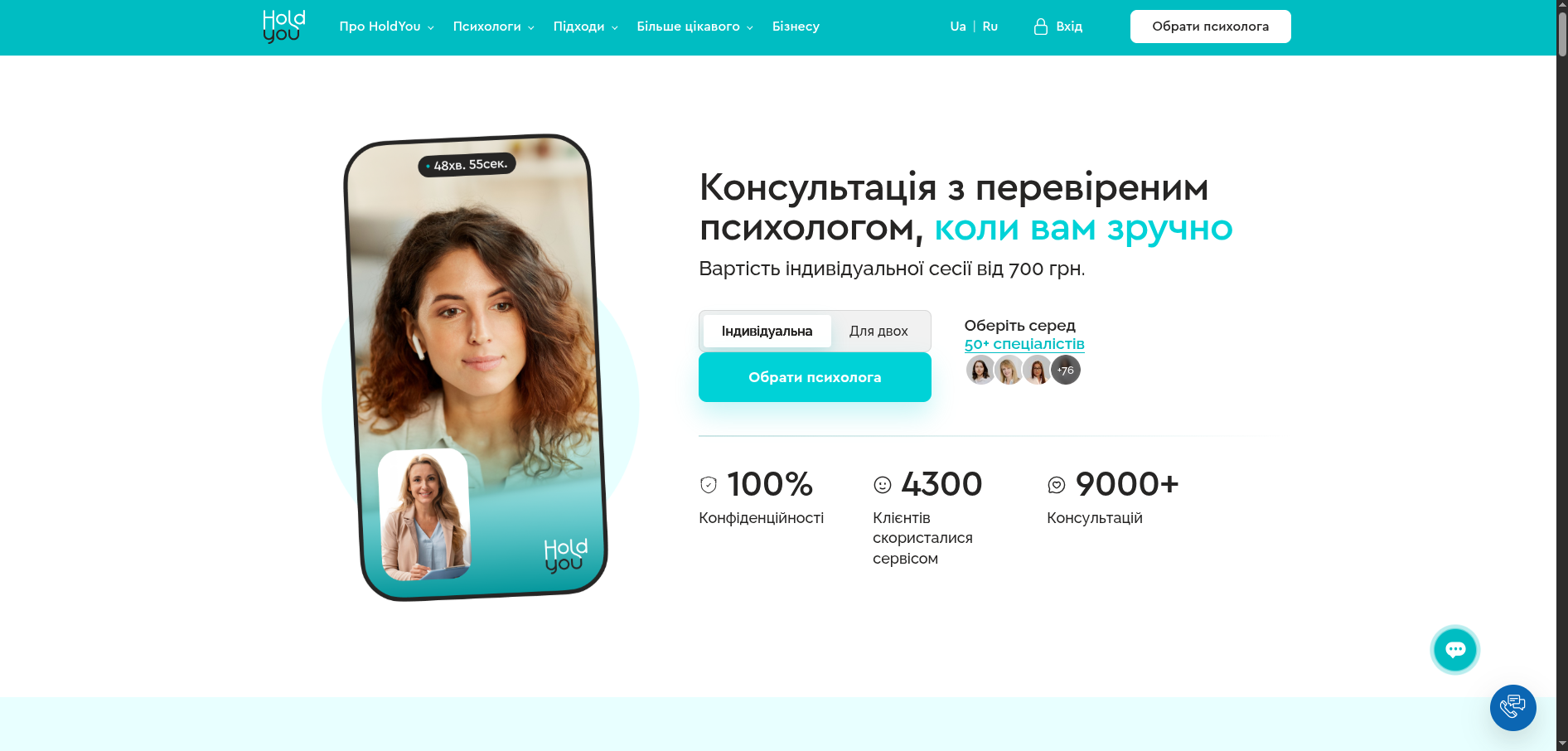

Challenge: HoldYou was growing fast — 4,300+ clients and 82 psychologists across 16 specializations — but the platform had three separate weak points holding it back: mobile performance was lagging, video/audio therapy calls were slow to connect, and there was no reliable way to record and store session recordings so clients could revisit them later. On top of that, frontend and backend teams were shipping against mismatched API contracts, causing avoidable bugs.
Solution: Rebuilt the mobile loading path with route-based code splitting, lazy loading and dependency pruning, cutting the JS bundle by 42% and dropping freeze time from 760ms to 110ms. Re-engineered the real-time video/audio call pipeline to cut call connection time down to just 5 milliseconds. Designed and built a session-recording system backed by Backblaze B2 (S3-compatible object storage) so every therapy session can be recorded, stored reliably, and streamed back to clients from their personal dashboard. Worked directly with the backend team inside agile sprints to align API contracts before implementation instead of after.
Result: 30% fewer integration bugs and faster release cycles, near-instant call connections for both clients and therapists, and a fully working session-history feature that turned one-off therapy calls into a lasting resource clients can return to — all on top of a noticeably smoother mobile experience for a platform serving thousands of clients and dozens of psychologists daily.
Therapy sessions live or die on call quality — a laggy connection at the start of a session is a bad first impression for both the client and the psychologist. The original call flow had noticeable delay between a user joining and the video/audio stream actually becoming live, which was disruptive for sessions that are often emotionally sensitive from the first second.
I reworked the connection handshake and stream initialization path for the video/audio pipeline, restructuring how the client and server negotiate the media stream instead of relying on the default setup flow. The result was call load time dropping to around 5 milliseconds — effectively instant from the user's perspective — so sessions now start the moment both participants join, with no waiting, no frozen frame, and no awkward pause at the start of a psychologist appointment.
Clients asked for a way to revisit their sessions — therapy is often easier to process after the fact, and psychologists wanted a reliable record for continuity of care. I built the feature end-to-end: each session is captured during the call and uploaded to Backblaze B2, an S3-compatible object storage service, chosen for its lower storage cost at scale compared to running the same volume through AWS S3 directly.
On the client side, every recorded session appears in the user's personal dashboard, where they can browse their session history and play back any past appointment on demand. I handled the full pipeline — secure upload after each call, reliable storage in B2, and low-latency streaming back to the client — so recordings are available soon after a session ends and playback stays smooth even as the platform scaled past 500+ recorded sessions a month.